
The "Talk to Your Diagram" app runs on my own Claude API key. Every time a visitor clicks Apply, that call goes straight to Anthropic and gets billed against a credit I loaded myself, not a subscription, not a free tier. So when I put $20 on the account back in May, the honest answer to "how long will this last" was: no idea.
A couple of months and a fair amount of testing later, I finally checked. Here is exactly what the console shows, and what it means.
Credit granted
$20.00
Remaining balance
$17.78
Spent so far (since May 16)
$2.22
This month's spend
$1.32 of a $20 monthly cap (7%)
Credit expires
May 17, 2027
Auto-reload
Off
All numbers straight from the Claude Platform billing page, on the date this was written.
The billing page shows more than one figure, and it is easy to mix them up. The credit balance ($17.78) is the real money left, this is what actually pays for API calls, token by token. The monthly spend cap ($1.32 of $20, resetting August 1) is something else entirely, a self-imposed limit I set so a bug or a runaway script could never rack up a surprise bill in a single month. It resets every month and has nothing to do with the total balance. And the expiration date (May 17, 2027) is a hard deadline attached to the credit itself: whatever is left on that date simply disappears, credit does not roll over indefinitely just because it has not been spent.
Three numbers, three jobs: one is what I have, one is how fast I am allowed to spend it in a given month, one is the clock counting down regardless of pace.
$20.00 minus $17.78 leaves $2.22 spent over roughly 58 days, about four cents a day. Stretch that same rate across the full year the credit is valid for, and the projected total lands around $14, leaving a few dollars unused when the credit expires in May 2027.
That is a real number, but it comes with a large asterisk. Almost all of that $2.22 is me testing my own app: clicking Apply, checking the diagram, breaking things on purpose to find bugs. It is not real traffic. Once this gets posted and people I do not know start clicking Apply on their own, the pace could look nothing like four cents a day. I have no way to predict that number yet, and I would rather say so than pretend the four-cent figure is a forecast.
The numbers above are the aggregate, the whole account since May. What they did not show, until now, is what a single call costs. That turned out to be an easy gap to close.
The Talk to Your Diagram app now reads the usage object Anthropic sends back with every API response, input tokens and output tokens, and multiplies each by Claude Opus 4.6's published rate: $5.00 per million input tokens, $25.00 per million output tokens. That is the same math behind the invoice, not a guess dressed up as one.
Here is what that looked like on an actual call, editing a customer onboarding sequence diagram to add a risk-based expedited approval path:
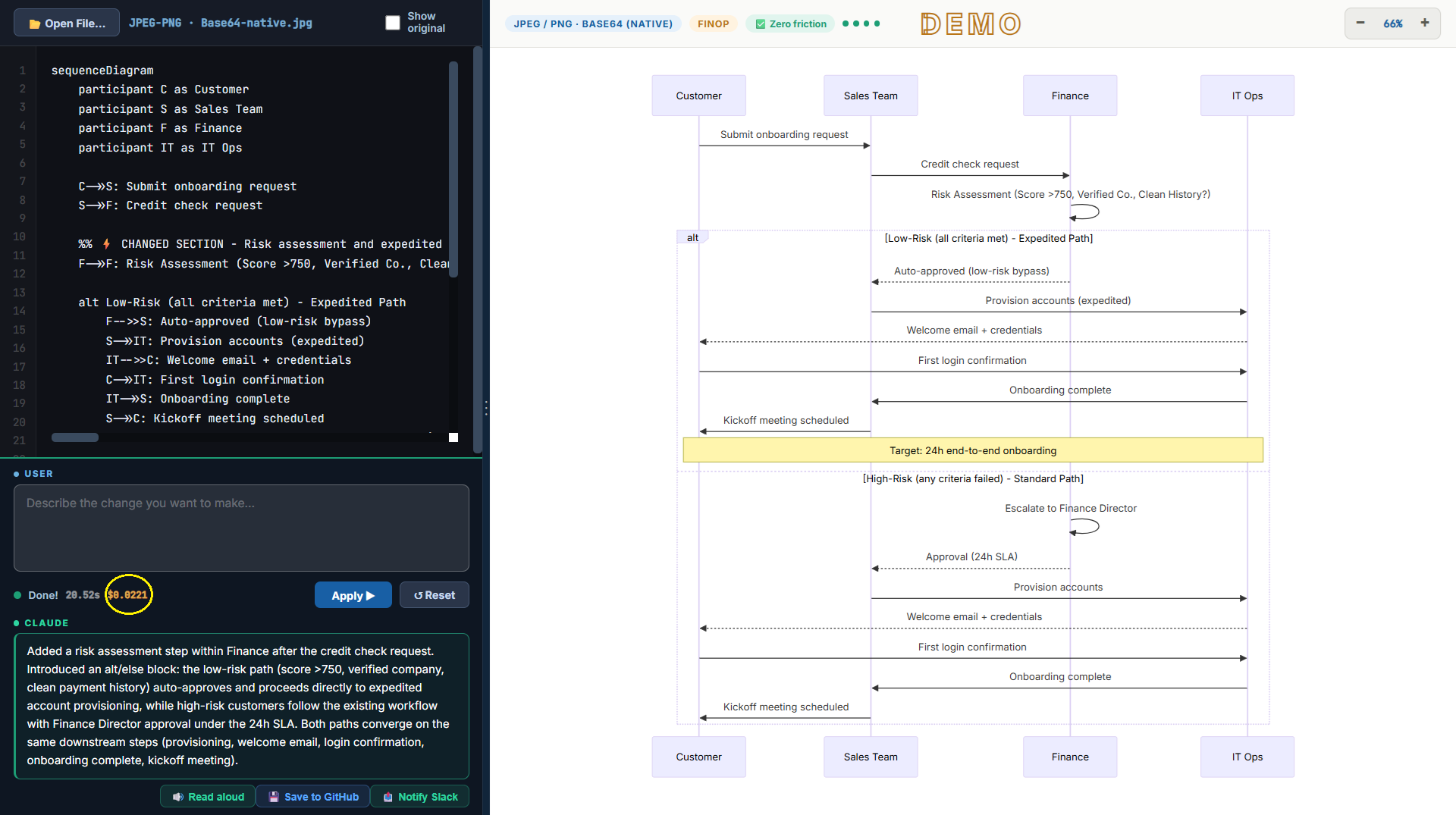
Live from the app: 20.52 seconds, $0.0221.
Just over two cents, for a change that took about 20 seconds to process. Most of that sits on the output side: output tokens are priced five times higher than input tokens, and this particular request rewrote the diagram end to end and wrote a multi-sentence explanation to go with it. A smaller edit, or one touching fewer lines, costs less; a bigger diagram or a longer explanation costs more. The number updates live, right next to the seconds counter, every time Apply is clicked.
Two things matter more to me than the exact dollar figure. Auto-reload is off, on purpose, so if the balance ever hits zero, the app does not silently keep charging my card, it just stops working and shows an error, the same "Failed to fetch" message I ran into while testing this myself. That is the trade-off of staying in control of spend: a dead demo is annoying, an unexpected bill is worse.
The other thing is the expiration date itself. A year sounds like a long runway, but it is a real deadline, not a soft suggestion, so this page is as much a note to my future self as it is a post for anyone else: check back before May 2027.
This is the part of building with AI that rarely gets talked about publicly. Everyone shows the demo. Fewer people show the meter running underneath it.